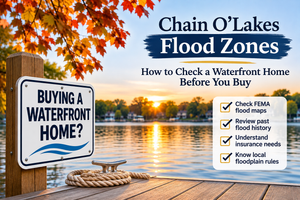
Quick Answer: Before buying a waterfront home on the Chain O'Lakes in Northern Illinois, check the property's FEMA flood map, ask about previous flooding, obtain a property-specific flood insurance quote, and investigate any floodplain building restrictions. Not every waterfront home is in a high-risk flood zone, and properties outside those zones can still experience flooding.
Why Flood Zones Matter When Buying a Chain O'Lakes Home
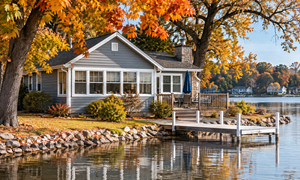
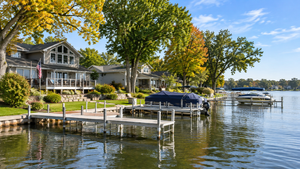
Imagine finding a waterfront home with beautiful lake views, a private pier, and convenient access to boating and fishing.
It might seem like the perfect place to enjoy the Chain O'Lakes lifestyle.
But before purchasing, there is another important consideration: understanding the property's flood risk.
The Chain O'Lakes region spans portions of Lake County and McHenry County in Northern Illinois. Communities including Fox Lake, Antioch, Ingleside, Johnsburg, and Spring Grove offer different types of waterfront properties along lakes, channels, and the Fox River.
Each property has its own characteristics, including elevation, drainage, shoreline conditions, and proximity to mapped flood hazard areas.
A beautiful waterfront location does not automatically mean a property has a high flood risk. However, it does make investigating water-related concerns especially important.
Here are the steps we recommend buyers take before purchasing.
1. How Do You Check Whether a Chain O'Lakes Home Is in a Flood Zone?
Start with the Federal Emergency Management Agency, commonly known as FEMA.
FEMA maintains official flood hazard maps used by communities, insurance professionals, lenders, and property owners.
You can search for a specific property using the FEMA Flood Map Service Center.
To begin:
Enter the property's street address.
Review the available flood map.
Identify the flood zone affecting the property.
Check the map's effective date.
Ask your lender or local floodplain administrator to help interpret anything unclear.
Remember that a parcel may contain different flood designations, and the location of the actual home matters.
The property's flood designation should be verified for the specific building, not assumed from its proximity to the water.
For a broader overview of evaluating waterfront properties, read our Chain O'Lakes Waterfront Home Buying Guide.
2. What Do FEMA Flood Zone Designations Mean?
FEMA flood maps identify different levels and types of flood hazards.
Some common designations include:
Zone AE: An area with a 1% annual chance of flooding where base flood elevations have been determined.
Zone A: An area with a 1% annual chance of flooding where detailed base flood elevations may not be available.
Zone X: A designation that can represent areas outside the mapped 1% annual-chance floodplain. Shaded and unshaded Zone X areas can have different levels of mapped flood risk.
The term 100-year floodplain can be misleading.
It does not mean flooding happens only once every 100 years. It generally refers to an area with a 1% chance of flooding in any given year.
Flooding can happen more than once within a relatively short period.
A flood map is a valuable starting point, but it does not predict every possible flooding event.
3. Does Every Chain O'Lakes Waterfront Home Require Flood Insurance?
No. Waterfront location alone does not automatically make flood insurance mandatory.
Whether coverage is required depends on factors including the location of the building, the applicable flood designation, and the financing arrangement.
For certain federally regulated or federally backed mortgages, flood insurance is generally required when the building securing the loan is located in a Special Flood Hazard Area.
Individual lenders may also have additional requirements.
Even when coverage is not mandatory, buyers should consider whether purchasing flood insurance makes sense for their property.
Standard homeowners insurance generally does not cover flooding as defined by flood insurance policies.
Our recommendation: Contact your lender and an insurance professional before completing your purchase.
Ask for a quote based on the actual property, rather than assuming that insurance will cost the same as it does for another waterfront home.
Learn more through the National Flood Insurance Program.
4. What Should Buyers Ask About Previous Flooding?
Flood maps tell only part of the story.
A property's history may reveal important information about how it has handled heavy rain, rising water levels, snowmelt, and drainage problems.
Questions worth asking include:
Has water ever entered the basement, crawl space, or living areas?
Has the property experienced flooding from the lake, river, or nearby channels?
Have sump pumps or drainage systems failed?
Have there been previous flood-related repairs?
Are there records of insurance claims or water damage?
Have mechanical systems ever been damaged by water?
Are there known drainage concerns during heavy rain?
Review the seller's disclosures and ask follow-up questions when necessary.
A home inspection can also help identify visible signs of moisture or drainage problems, although a standard inspection cannot guarantee that flooding will never occur.
When appropriate, consider additional evaluations by qualified drainage, foundation, or waterproofing professionals.
5. Why Does the Home's Elevation Matter?
Two waterfront homes on the same lake may have very different elevations.
One may sit on higher ground with a walkout basement, while another may be closer to the water's elevation.
That difference can affect flood exposure and insurance considerations.
Buyers may want to ask whether an elevation certificate or other reliable elevation documentation is available.
An elevation certificate provides information about a building's elevation in relation to certain floodplain measurements.
It can be useful for floodplain compliance questions and may help insurance professionals evaluate certain coverage or rating considerations.
Not every property has an elevation certificate, and not every flood insurance quote requires one.
If elevation information is important to your purchase, ask your lender, insurer, surveyor, or local floodplain administrator what documentation is appropriate.
6. Can You Renovate a Waterfront Home Located in a Floodplain?
Potentially, but additional rules may apply.
This is particularly important for buyers considering major renovations, additions, substantial improvements, grading changes, or shoreline projects.
Illinois has floodway and floodplain regulations intended to reduce flood damage and protect the movement and storage of floodwater.
Depending on the property and proposed work, approvals may be required from local authorities, the Illinois Department of Natural Resources, or other agencies.
For example, a buyer planning to expand a waterfront home should investigate whether the proposed addition is permitted before assuming the project can move forward.
The same principle applies to certain shoreline improvements, grading projects, and other construction near waterways.
The Illinois Department of Natural Resources Office of Water Resources provides information about floodway construction and permitting.
Before purchasing a waterfront home with renovation plans, verify the rules for that specific property with the appropriate permitting authorities.
7. What About Docks, Seawalls, and Shoreline Improvements?
Floodplain research should not stop at the house itself.
Waterfront buyers should also evaluate existing improvements along the shoreline.
Depending on the property, these may include:
Seawalls and retaining walls
Piers and docks
Boat lifts
Shoreline stabilization
Drainage systems
Grading or fill near the water
Existing improvements do not automatically establish that future repairs, replacements, or expansions will be approved.
Buyers should ask for available permits, inspection records, and maintenance information.
For additional guidance, see our Chain O'Lakes Piers, Seawalls and Shorelines Buying Guide.
8. Can a Home Outside a FEMA High-Risk Flood Zone Still Flood?
Yes.
This is one of the most important things waterfront buyers should understand.
A property located outside a mapped Special Flood Hazard Area can still experience flooding.
Possible causes include:
Heavy rainfall and surface-water runoff
Inadequate drainage
Basement seepage
Sewer backups
Changing water levels
Localized flooding that may not be fully represented on a FEMA map
Flood insurance and homeowners insurance policies may treat different types of water damage differently.
That is why buyers should investigate both the property's mapped flood designation and its actual drainage and water-intrusion history.
9. Which Local Agencies Can Help Chain O'Lakes Buyers?
Because the Chain O'Lakes extends across multiple jurisdictions, the correct agency depends on the property's location.
Start with these resources:
FEMA: Official flood hazard maps and mapping information.
Illinois Department of Natural Resources: State floodway regulations, water resources, and certain permitting requirements.
McHenry County: Water resources and floodplain information for properties within the county's jurisdiction.
Lake County: Floodplain and stormwater management information for applicable properties.
Local municipalities: Building departments and floodplain administrators can help explain local regulations, permits, and available records.
Buyers should confirm which government authority has jurisdiction over the particular property.
10. What Should You Verify Before Making an Offer?
A waterfront home purchase involves more than deciding whether you love the view.
Before committing, we recommend addressing these important questions:
What does the effective FEMA flood map show for the home?
Has the property experienced flooding or repeated water intrusion?
Is flood insurance required by the lender?
What would flood insurance cost for this specific property?
Are elevation documents available?
Are there visible drainage or foundation concerns?
Could floodplain restrictions affect planned renovations?
Are shoreline improvements properly documented?
Which local authority regulates the property?
Have the appropriate professionals reviewed any unresolved concerns?
The answers can help you make a more informed decision about the property, its potential expenses, and your future plans.
The Star Home Team's Perspective
Waterfront real estate requires a different level of research than many traditional residential properties.
A home on Fox Lake, Pistakee Lake, Grass Lake, or a connecting channel may offer an excellent lifestyle, but the details of each property matter.
At The Star Home Team, we encourage buyers to look beyond the listing photos and investigate the practical considerations of waterfront ownership.
That includes understanding boating access, shoreline improvements, maintenance responsibilities, and potential flood-related concerns.
Our goal is to help buyers ask better questions, identify the appropriate resources, and make confident, informed real estate decisions.
For additional information, explore our guide to choosing a Chain O'Lakes waterfront real estate agent.
Frequently Asked Questions About Chain O'Lakes Flood Zones
Is every Chain O'Lakes waterfront home in a flood zone?
No. Not every waterfront home is located in a FEMA-designated high-risk flood zone. Flood designations depend on the property's specific location and mapped conditions. Buyers should check the address through FEMA and verify the designation affecting the building with the appropriate professionals.
How do I find out whether a house in Fox Lake is in a flood zone?
Visit FEMA's Flood Map Service Center and search the property's address. Review the available flood map and its effective date. If the designation is unclear, contact your lender or local floodplain administrator for assistance interpreting the information.
Is flood insurance required when buying a lakefront home in Illinois?
Not always. Flood insurance requirements depend on the property's flood designation and the type of mortgage financing, among other factors. Certain federally regulated or federally backed loans require coverage for buildings in Special Flood Hazard Areas. A lender may impose additional requirements.
Can a house outside a flood zone still flood?
Yes. Properties outside mapped high-risk flood areas can experience flooding from heavy rainfall, surface-water runoff, drainage problems, and other sources. FEMA maps are an important tool, but buyers should also investigate the property's history and physical condition.
What is a 100-year floodplain?
A 100-year floodplain generally refers to an area with a 1% annual chance of flooding. It does not mean flooding can occur only once every 100 years. Multiple flooding events can occur within a shorter period.
Can I add onto a waterfront home in a floodplain?
Possibly, but construction may be subject to local and state floodplain requirements. The scope of the proposed improvements and the property's location can affect what is allowed. Buyers should consult the applicable building department and permitting authorities before making renovation plans.
Does homeowners insurance cover flooding from the lake?
Standard homeowners insurance generally excludes flood damage. Separate flood insurance may be available through the National Flood Insurance Program or private insurers. Coverage terms, exclusions, limits, and waiting periods should be reviewed with a licensed insurance professional.
Should I avoid buying a Chain O'Lakes home in a flood zone?
Not necessarily. A flood designation is one factor to consider alongside the home's condition, elevation, insurance costs, financing, and your plans for the property. Understanding the specific risks and potential expenses is more useful than making a decision based solely on whether the property is near water.
Thinking About Buying a Chain O'Lakes Waterfront Home?
The Chain O'Lakes offers a distinctive waterfront lifestyle, with opportunities for boating, fishing, recreation, and year-round living.
Understanding a property's flood risk is an important part of determining whether a home is the right fit.
At The Star Home Team, we help buyers throughout Northern Illinois explore waterfront properties and understand the considerations that make these homes different.
Whether you're searching in Fox Lake, Antioch, Johnsburg, Spring Grove, or another Chain O'Lakes community, our team can help guide your real estate search.
Explore more waterfront buying resources or contact The Star Home Team to begin your search.
Sources and Helpful Resources
Federal Emergency Management Agency, Flood Map Service Center: https://msc.fema.gov/portal/home
National Flood Insurance Program, FloodSmart: https://www.floodsmart.gov/
Illinois Department of Natural Resources, Office of Water Resources, Permit Programs: https://dnr.illinois.gov/waterresources/permitprograms.html
Illinois Department of Natural Resources, Guide to Floodproofing: https://dnr.illinois.gov/waterresources/guidetofloodproofing.html
About the Author | The Star Home Team
Susan Starwalt is the Broker Owner of Better Homes and Gardens Real Estate Star Homes and The Star Home Team, serving Northern Illinois and Southern Wisconsin.
Licensed since 1998, Susan works alongside Jim Starwalt and the company's management team to provide real estate leadership, local market expertise, and personalized service.
The Star Home Team has helped more than 4,000 families buy and sell homes throughout Lake County, McHenry County, Kenosha County, and surrounding communities.
Our team is licensed in Illinois and Wisconsin and helps buyers and sellers navigate real estate decisions with knowledgeable guidance and local experience.
Better Homes and Gardens Real Estate Star Homes | The Star Home Team
Grayslake and McHenry, Illinois | Serving Northern Illinois and Southern Wisconsin
Website: https://www.starhometeam.com/