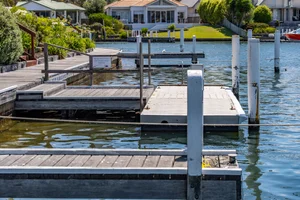
Buying a Chain O’Lakes waterfront home means evaluating more than the house. Buyers should also understand the condition and history of the seawall, pier and shoreline, confirm water access and depth, investigate flood risk, and determine which government agencies may regulate future waterfront improvements. The right questions before closing can prevent expensive surprises later.
The Water’s Edge Is Part of the Property Decision
A private pier, boat lift and backyard access to the Chain O’Lakes can be major reasons to choose a waterfront home.
But when we help buyers evaluate waterfront property, we encourage them to look beyond the view.
The area between the house and the water can include a seawall, natural shoreline, riprap, pier, dock, boat lift, electrical service, drainage systems and landscaping. Each can affect how the property is used and maintained.
Buyers who are new to waterfront ownership may want to start with our guide to buying a home on the Chain O’Lakes.
Then, when considering a specific property, take a closer look at the water’s edge.
1. What Condition Is the Seawall In?
A seawall can be easy to overlook when the house, lake view and boat access are getting most of your attention.
Look closely.
Depending on its construction and age, signs worth investigating may include:
Leaning or bowing sections
Cracking
Separation between sections
Soil loss behind the wall
Erosion
Areas that appear to have been patched or repaired
Drainage problems behind the wall
Visible movement or deterioration
A buyer should not assume that an existing seawall is in good condition simply because it is still standing.
If there are concerns, consider obtaining an evaluation from an appropriately qualified professional familiar with shoreline structures.
Our Chain O’Lakes lakefront home maintenance guide covers additional maintenance considerations unique to waterfront ownership.
2. Who Regulates a Seawall or Pier on the Chain O’Lakes?
This is an important question because the answer can involve more than one government authority.
The Fox Waterway Agency states that it does not regulate piers or seawalls. Its guidance directs property owners to the U.S. Army Corps of Engineers and the Illinois Department of Natural Resources for permitting questions and also advises owners to consult their municipality or county because additional approvals may be required.
IDNR's Office of Water Resources regulates work in and along certain Illinois rivers, lakes, streams, floodways and public waters. IDNR also maintains statewide and regional permits for certain qualifying activities, including minor boat docks and minor shoreline protection projects. Whether a particular project qualifies for an existing authorization or requires an application depends on the project and location.
The practical lesson for a buyer is simple:
Do not assume that because a pier or seawall already exists, you can automatically replace, enlarge or substantially modify it however you want.
Verify requirements before planning future work.
3. Does the Property Fall Under Lake County, McHenry County or a Municipality?
The Chain O’Lakes extends across Lake and McHenry Counties and includes incorporated municipalities as well as unincorporated areas.
That matters because local permitting authority can vary by location.
Lake County states that a Site Development Permit may be required for seawalls, grading, filling, floodplain development and other qualifying projects in unincorporated areas.
McHenry County identifies development in flood hazard areas and wetlands or waters among activities that can require a Stormwater Management Permit. The county also specifically advises property owners that work within the Chain O’Lakes, Fox River or other floodway areas may require IDNR authorization.
Our guide to the communities around the Chain O’Lakes explains why location can be more complicated here than simply identifying the nearest town.
For any specific property, confirm the actual jurisdiction rather than relying only on the mailing address.
4. What Do We Know About the Existing Pier?
If a property has a pier or dock, ask questions about the structure itself.
For example:
How old is it?
Is it permanent, removable or seasonal?
What material is it made from?
Who installs and removes it, if applicable?
Where is it stored?
Has it needed significant repairs?
Are there electrical components?
Is a boat lift included with the sale?
Are there documents relating to prior installation or authorization?
If documentation exists for waterfront improvements, ask to review it.
IDNR identifies minor boat docks among the activities addressed through its statewide permit program, but buyers should not assume every dock automatically meets those requirements.
5. Is the Water Deep Enough for Your Boat?
Having a pier does not necessarily mean a property works for every boat.
Water depth can vary by location and conditions. Fox Waterway Agency notes that water levels across the Chain O’Lakes can change with weather, seasonal patterns and water-management efforts.
When boating access matters to your purchase, investigate:
Typical depth at the end of the pier
Depth along the route from the pier to navigable water
Possible underwater obstructions
Boat lift capacity and dimensions
Clearance needed for your particular boat
Whether seasonal water conditions affect access
Visit the property from the water when practical. What looks perfect from the backyard can feel very different when approaching by boat.
6. Is It Open Water, a Channel or a Protected Area?
Waterfront exposure can change the ownership experience.
A home on open water may experience different waves, boat traffic and shoreline exposure than a home on a protected channel or bay-like area.
Channel properties can also differ in width, depth, traffic and ease of navigation.
Our guide comparing channel, bay and open-water properties on the Chain O’Lakes explains these differences in greater detail.
Think about how you plan to use the water rather than focusing only on whether a listing says "waterfront."
7. What Kind of Shoreline Does the Property Have?
Not every waterfront home has a traditional seawall.
You may encounter:
Concrete or steel seawalls
Rock or riprap stabilization
Natural shoreline
Vegetated shoreline
A combination of shoreline treatments
Look for erosion, exposed soil, settlement and areas where runoff appears to flow toward the water.
Shoreline work can be regulated, so a plan to "fix the shoreline later" should not be treated as a simple landscaping project until the applicable requirements have been checked.
8. Where Is the Actual Property Boundary?
The visible shoreline is not a substitute for a survey.
Before making assumptions about lot lines, pier placement or waterfront boundaries, review the available survey and title information and consult appropriate professionals when questions arise.
This becomes especially important when a pier appears close to a neighboring property or when fences, retaining structures or other improvements are near property lines.
A beautiful waterfront view does not answer a boundary question.
9. Is the Home in or Near a Flood Hazard Area?
Flood risk deserves separate attention when evaluating waterfront real estate.
FEMA's Flood Map Service Center is the official source for National Flood Insurance Program flood-hazard mapping products. Buyers can search a property's address and review applicable flood maps.
A buyer may also want to investigate:
Current FEMA mapping
Available elevation information
Prior flooding disclosed or otherwise documented
Drainage around the house
Sump pump and backup systems
Location of mechanical equipment
Insurance availability and cost
A flood map is an important starting point, but it is not the only information worth considering.
10. What Waterfront Improvements Are Included in the Sale?
Do not assume everything visible at the property automatically transfers with the home.
Ask what is included, particularly when you see:
Pier or dock sections
Boat lifts
Canopies
Shore stations
Waterfront furniture
Storage boxes
Kayak racks
Electrical equipment
Dock accessories
The purchase contract should clearly address important personal property that the buyer expects to receive.
11. What Will the Waterfront Cost to Maintain?
A waterfront home can have maintenance needs that a typical residential property does not.
Before purchasing, think beyond the first summer.
Potential future projects may include pier repair or replacement, shoreline stabilization, seawall work, boat-lift service, electrical maintenance, erosion control and landscaping.
A buyer does not need to know exactly what every future project will cost. The goal is to recognize which components exist, understand their present condition and anticipate that they will require maintenance.
12. Does the Location Fit How You Want to Use the Chain?
The Chain O’Lakes is not one uniform body of water.
Fox Waterway Agency describes Zone C as extending from the mouth of the Fox River at Pistakee Lake north to the Wisconsin state line and including all 15 interconnected lakes in the system.
Properties can offer very different waterfront experiences depending on location.
Explore our Chain O’Lakes lake guide to become familiar with the broader waterway before narrowing your home search.
A Practical Waterfront Checklist for Buyers
Before buying a Chain O’Lakes waterfront home, consider asking:
What is the condition of the seawall or shoreline?
What is the condition of the pier?
Are permits, approvals or other records available for prior waterfront improvements?
Which government entities have jurisdiction over this property?
What future shoreline or pier work might be needed?
What is the water depth near the pier?
Can your boat comfortably access the property?
What is included in the sale?
Is the property in or near a mapped flood hazard area?
Are there visible drainage or erosion issues?
Is the property on open water, a channel or a more protected location?
Does the waterfront configuration match how you actually plan to use the property?
The Star Home Team's Perspective
When we work with buyers on the Chain O’Lakes, we encourage them to evaluate the waterfront with the same attention they give the roof, foundation, mechanical systems and interior of the home.
The pier, seawall and shoreline can be central to why someone wants the property in the first place.
That makes them worth investigating before the purchase, not after.
We also avoid making assumptions about what a buyer can build, replace or modify along the shoreline. Regulations can depend on the location and scope of a project, so questions about future improvements should be verified with the appropriate government agencies.
The goal is not to make waterfront buying complicated. It is to help buyers understand what they are purchasing so they can enjoy the Chain O’Lakes with fewer surprises.
Frequently Asked Questions
Do I need a permit for a pier on the Chain O’Lakes?
Permit requirements depend on the project and location. Fox Waterway Agency states that it does not regulate piers or seawalls and directs these questions to the Illinois Department of Natural Resources and U.S. Army Corps of Engineers. Local municipal or county requirements may also apply. Buyers and owners should verify requirements for the specific property and proposed work before construction.
Does the Fox Waterway Agency issue seawall permits?
No. Fox Waterway Agency specifically states that it does not regulate piers or seawalls. It directs property owners to IDNR and the U.S. Army Corps of Engineers and recommends checking with the appropriate municipality or county for additional requirements.
What should I inspect on a seawall before buying a lakefront home?
Look for leaning, bowing, cracks, separation, erosion, soil loss behind the wall, drainage problems and evidence of significant repairs. If the seawall's condition is uncertain, consider consulting an appropriately qualified professional familiar with shoreline structures.
Should I check water depth before buying a Chain O’Lakes home?
Yes, particularly if boating is an important reason for buying the property. Investigate depth near the pier and the route to navigable water, along with boat-lift specifications and seasonal conditions. Fox Waterway Agency notes that water levels can change because of weather, seasonal patterns and water-management efforts.
Is every Chain O’Lakes waterfront home in a flood zone?
Do not assume that every waterfront property has the same flood classification. FEMA provides official flood-hazard mapping through its Flood Map Service Center. Check the individual property and discuss insurance requirements and costs with appropriate insurance and lending professionals.
Can I replace an existing seawall after buying the home?
Possibly, but do not assume replacement can occur without regulatory review. Depending on the location and work proposed, state, federal, county or municipal requirements may apply. Determine the property's jurisdiction and contact the appropriate agencies before designing or beginning the project.
Is a channel-front home different from an open-lake home?
Yes. Water depth, boat traffic, wave exposure, views, shoreline conditions and navigation can vary substantially between channel, protected and open-water locations. Buyers should evaluate the specific property based on how they plan to use the waterfront.
What documents should I ask for when buying a waterfront property?
Depending on the property, useful records may include surveys, available permits or approvals for waterfront improvements, documentation regarding the pier or seawall, flood information, inspection reports and information about included boat lifts or other waterfront equipment. Your real estate agent and attorney can help identify documents appropriate to the transaction.
Conclusion
A Chain O’Lakes home can offer something special: the ability to step outside your back door and enjoy one of Northern Illinois' most distinctive waterway systems.
But waterfront buying requires looking at more than the house.
Take time to understand the pier. Examine the seawall and shoreline. Investigate water depth and access. Review flood information. Identify the property's jurisdiction. And when future waterfront improvements matter to your decision, verify what is permitted before you buy.
The Star Home Team works throughout Lake County, McHenry County and the Chain O’Lakes region and can help buyers explore waterfront properties with these questions in mind.
Sources
Fox Waterway Agency
“What are the Pier and Seawall Requirements?”
Updated 2026
Fox Waterway Agency source
Fox Waterway Agency
“Water Levels”
Current 2026 page
Fox Waterway Agency water levels
Fox Waterway Agency
“Waterway Zones”
Current 2026 page
Fox Waterway Agency waterway zones
Illinois Department of Natural Resources, Office of Water Resources
“Permit Program”
IDNR permit program
Illinois Department of Natural Resources, Office of Water Resources
“Permit Application and Instructions”
IDNR permit application information
Illinois Department of Natural Resources, Office of Water Resources
“Permits - Statewide, Regional, General”
IDNR statewide and regional permits
Lake County, Illinois
“Site Development Permit”
Lake County source
McHenry County Department of Planning & Development
“Do I Need a Stormwater Management Permit?”
McHenry County source
Federal Emergency Management Agency
“What Is My Flood Zone?”
FEMA flood-zone information
About the Author
Susan Starwalt is the Broker Owner of Better Homes and Gardens Real Estate Star Homes and The Star Home Team, serving Northern Illinois and Southern Wisconsin. Licensed since 1998, Susan works alongside Jim Starwalt and the company's management team to support one of the region's top-producing real estate organizations.
The Star Home Team has helped more than 4,000 families buy and sell homes and is recognized as one of Illinois' leading real estate teams. The team serves buyers and sellers throughout Lake County, McHenry County, Kenosha County, and surrounding communities, providing expert guidance, local market knowledge, innovative marketing, and personalized service.
Ready to Take the Next Step?
Whether you're buying your first home, selling your current property, relocating, or simply exploring your options, The Star Home Team is here to help.
• Click here to search homes for sale.
• Learn more about buying and selling real estate in Northern Illinois and Southern Wisconsin by visiting our Real Estate Resource Center.
• Fill out our Contact Us form online to tell us about your real estate goals or send us a message anytime.
The Star Home Team proudly serves buyers and sellers throughout Northern Illinois and Southern Wisconsin.
Licensed in Illinois and Wisconsin.